
Physical testing is the bottleneck
Hardware access, safety constraints, or slow reset cycles make iteration too expensive to run entirely in the real world.
Fitzroy designs domain-specific virtual training environments, develops purpose-built control policies, and builds the complete AWS machine learning pipeline that carries robot learning into physical operations.
MuJoCo PPO GRPO TD3 SAC DQN λ-SARSA PyTorch C++17 AWS
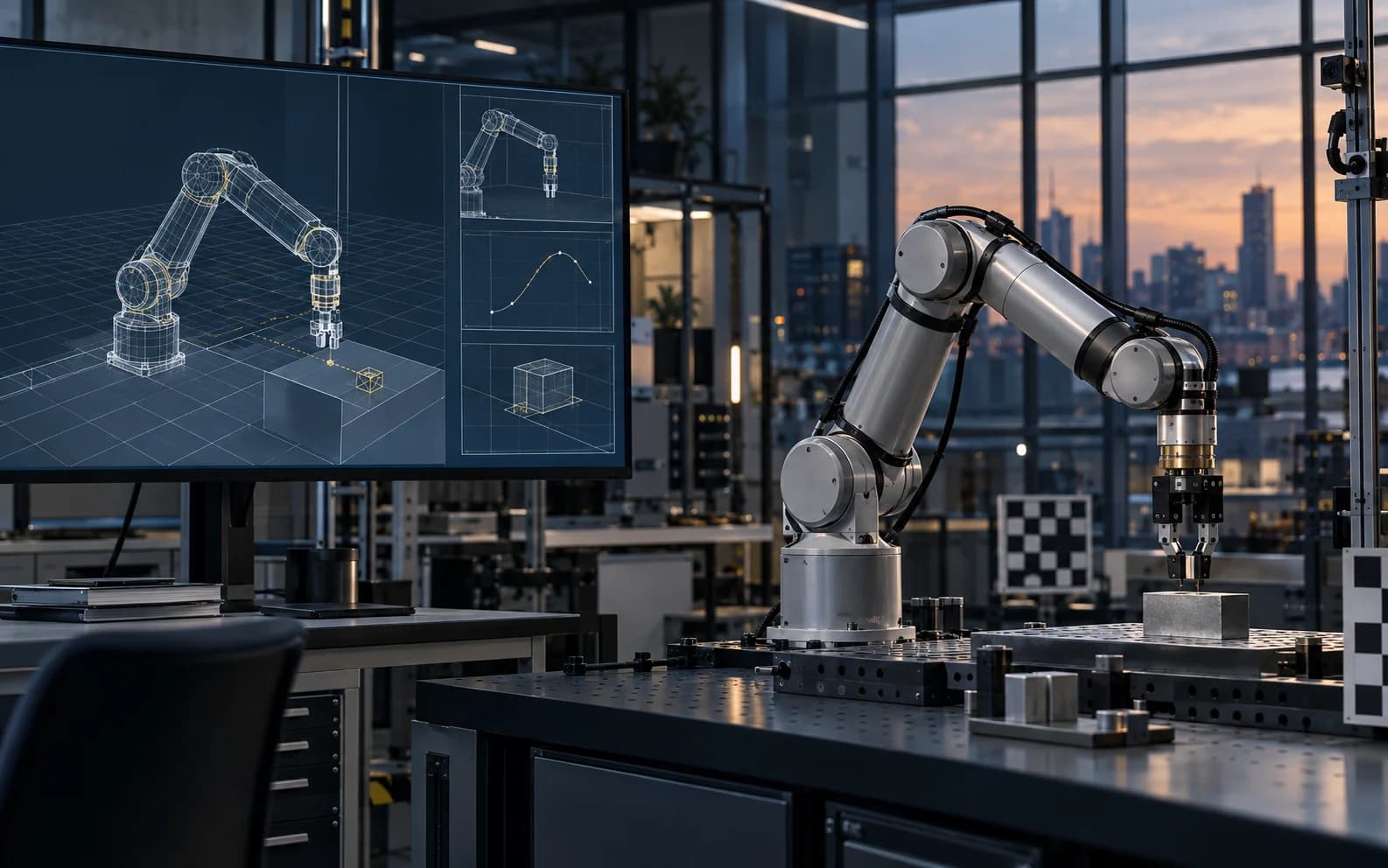
We connect simulation, learning, validation, edge deployment, and field feedback into one domain-specific engineering system—so teams can iterate faster without treating the real world as the first test environment.
Simulation environment and digital-twin design
Synthetic data and domain scenario generation
Reinforcement and imitation learning pipelines
PPO, GRPO, TD3, SAC, DQN, λ-SARSA, and actor–critic systems
Domain-specific policy and reward design
AWS ML platform architecture and MLOps
Sim-to-real transfer and system calibration
Edge inference and fleet deployment
Safety validation, observability, and iteration
Telemetry-driven evaluation and retraining
The hardest problems tend to sit between disciplines: controls and ML, simulation and hardware, research code and production operations. The failure is rarely the algorithm—it is everything around it.
Hardware access, safety constraints, or slow reset cycles make iteration too expensive to run entirely in the real world.
A model succeeds in a narrow environment but fails when lighting, payloads, friction, geometry, or operator behavior changes.
Training produces a model artifact, but there is no reliable path into the robot runtime, fleet controls, or release process.
Telemetry exists, but it is not structured into scenarios, evaluation sets, and the next training cycle.
The model is only one part of the system. We engineer the environment, training pipeline, transfer tests, runtime, and feedback path together so each field deployment makes the next policy stronger.
Recreate the task, sensors, robot dynamics, and operational edge cases in a controllable virtual environment.
Run parallel reinforcement, imitation, or hybrid learning loops without consuming physical fleet time.
Measure robustness across randomized conditions, hardware limits, safety envelopes, and unseen scenarios.
Package policies for the target runtime, instrument field behavior, and route real-world data back into training.
We select and combine methods based on action space, reward quality, hardware limits, safety constraints, and the amount of real-world data available—not because one algorithm is fashionable.
Factory robotics and household robotics are separate examples—not data sources for one combined model. Each program gets its own environments, reward system, data boundary, policy artifacts, validation gates, and deployment path.
A practical default for stable, continuous control: walking, reaching, grasping, carrying, and coordinating whole-body motion across varied simulated environments.
ONE DOMAIN · ONE POLICY · CONTINUOUS CONTROL
Compares groups of attempts against one another, making it useful when a task can be completed in several valid ways and outcomes can be ranked with clear reward functions.
GROUPED ATTEMPTS WITHIN ONE DOMAIN-SPECIFIC POLICY
Learns the value of discrete actions. It fits bounded decisions such as select, stop, grasp, place, route, or recover inside a larger humanoid control stack.
DOMAIN-SPECIFIC MODEL · FINITE ACTION SET
Learns on-policy from the sequence the robot actually follows, carrying delayed task rewards backward across recent decisions through eligibility traces.
Pairs an actor that selects motion with a critic that estimates expected return—the foundation behind many continuous-control systems for dexterous and mobile robots.
ONE DOMAIN · ONE ACTOR–CRITIC SYSTEM
FastTD3 is an open-source C++17 implementation of FastTD3—a high-performance variant of Twin Delayed Deep Deterministic Policy Gradient (TD3) built for humanoid control—released under the MIT license.
View FastTD3 on GitHubTWIN CRITICS · DELAYED ACTOR · SOFT TARGET UPDATES
An Eigen-only build with no LibTorch dependency, and a full LibTorch/PyTorch build. Replay buffer, empirical normalization, target networks with soft updates, and Gaussian exploration noise.
A Python–C++ bridge through pybind11 running Humanoid-v5, HumanoidStandup-v5, Walker2d, HalfCheetah, Ant, and Hopper, with observation and reward normalization.
Google Test coverage for the replay buffer, normalizer, clipping, TD error, Huber loss, and soft updates, with builds automated through GitHub Actions.
Senior execution, not account management.
Berk Delibalta, Founder & Principal — M.S. Computer Science, AWS Solutions Architect, with enterprise technology experience at Deloitte, IBM, Zurich, and Thales. The person you speak to is the person who writes the code.
FastTD3 is research and educational code, not a product. It is shared as evidence of how the work is done: implemented from the algorithm up, wired to a real physics engine, and tested.
From raw sensor data and parallel simulation to training, evaluation, registry, staged edge release, telemetry, and retraining, Fitzroy can own the AWS platform—not just hand over a model file. We isolate model groups, data, evaluation gates, and release channels by operating domain.
Isolated domain data, demonstrations, sensor streams, and field telemetry in Amazon S3
AWS Batch or Amazon EKS workers running parallel GPU environments
Amazon SageMaker AI or custom PyTorch and Ray training pipelines
Separate domain model groups, evaluation gates, Model Registry, and Amazon ECR
Signed, staged edge releases through AWS IoT Greengrass
CloudWatch, fleet telemetry, drift signals, and automated retraining
AWS reference architecture
Robot telemetry, versioned domain data, and experiment scenarios.
 AWS IOT COREROBOT SENSORS + TELEMETRY
 AMAZON S3VERSIONED RAW + CURATED DOMAIN DATA
 SAGEMAKER AIEXPERIMENTS + SCENARIOS
Parallel GPU simulation, policy training, evaluation gates, and approved artifacts.
 AWS BATCHGPU SIMULATION JOBS
 AMAZON EKSPARALLEL RL WORKERSSAGEMAKER AI PIPELINESPREPARE → TRAIN → EVALUATEPOLICY TRAININGPPO · GRPO · DQNEVALUATIONSIM-TO-REAL + SAFETY GATESSAGEMAKER MODEL REGISTRYSEPARATE MODEL GROUP PER DOMAINAMAZON S3APPROVED MODEL ARTIFACTS
 AMAZON ECRRUNTIME CONTAINERS
 AWS KMSARTIFACT ENCRYPTION
 AWS IAMACCOUNT BOUNDARIES
Automated tests, packaging, and signed infrastructure for every release.
 AWS CODEPIPELINEMODEL + RUNTIME PROMOTION
 AWS CODEBUILDAUTOMATED TEST + PACKAGE
 AWS CLOUDFORMATIONSIGNED FLEET INFRASTRUCTURE AS CODE
Canary robots run each release behind hardware-in-the-loop and safety gates.
 AWS IOT GREENGRASSMODEL + EDGE RUNTIME
 AMAZON CLOUDWATCHHIL + SAFETY GATES
Staged releases to each domain fleet, with commands and telemetry.
AWS IOT GREENGRASSSTAGED DOMAIN RELEASEAWS IOT CORECOMMANDS + TELEMETRYFACTORY POLICY A · HOUSEHOLD POLICY B · SEPARATE RELEASE TARGETS
Model and fleet observability, drift signals, and retraining events.
AMAZON CLOUDWATCHMODEL + FLEET OBSERVABILITYAWS IOT COREDOMAIN FLEET SIGNALS AMAZON EVENTBRIDGERETRAIN + RELEASE EVENTS
A reproducible environment, learning pipeline, reward design, evaluation suite, and policy training stack built around the robot and task.
The data, GPU training, evaluation, registry, release automation, observability, security, and retraining infrastructure behind the models.
A production path for packaging, staged edge releases, monitoring, rollback, and continuous improvement across physical machines or a growing fleet.
Most programs begin with a feasibility review. Each stage ends with something your team can run—and a clear decision on whether the next stage is worth funding.
A written assessment of whether your task suits reinforcement learning at all, what the simulation must capture, and where the sim-to-real risk sits.
Often ends in a recommendation not to proceed.
A validated simulation environment—typically MuJoCo—for your robot and task, with reward specification, a baseline policy, and a reproducible training setup your team can run.
Policy development through evaluated performance across randomized conditions, with the transfer gap measured and reported, the evaluation harness, and handover documentation.
Edge packaging, staged fleet releases, telemetry-driven retraining, and continued iteration alongside your engineering team—typically two to three days a week.
Pricing is fixed per engagement and quoted after a short scoping call. Each stage follows Fitzroy’s assess, architect, build, productionize, and support method.
See how we workA defined starting point
Is a simulation-trained policy appropriate for this robot, task, and operating domain?
Typically one to two working weeks; fee, access, deliverables, and acceptance criteria agreed in the statement of work.
Review scope and deliverables →One to two weeks, fixed price, and a written answer on whether simulation-trained policies can work for your robot—including when the answer is no.